Cougar Cares Crisis Support

A mental health crisis can include but is not limited to:

  • You are feeling unsafe
  • You are hearing or seeing things that are not really there
  • You have recently experienced or witnessed violence (e.g. sexual assault, community violence, intimate partner violence, physical abuse, hate crime)
  • You are thinking about hurting others
  • You are considering suicide or self-harm

Call, email, or visit the CSU Cougar Cares Counseling Center, walk-ins are welcome during hours of operation:  Monday thru Thursday, 9:00 am – 6:00 pm, Fridays 9:00 am – 1:00 pm

Phone: 773-995-2383

Email:  counselingcenter@csu.edu

If you are trying to make contact after hours, please dial 773-995-2111 for the CSU Campus police for assistance.  Officers are available 24/7

For support outside of CSU, call 988 any time 24.7

Common Questions about Crisis Support

We cannot disclose any information that you share during a crisis call without your written permission, except in the following situations:

  • you are at clear, imminent risk of causing serious harm or death to yourself or another person
  • there is suspected abuse or neglect of a child or vulnerable adult (e.g., an adult with a developmental disability)
  • the records are court-ordered as part of an ongoing legal proceeding

In cases where we are legally or ethically obligated to break confidentiality, we share only the minimum required by law or to keep you or others safe. We also make every attempt to let you know in advance, and still seek your permission to do so.

When using crisis services, you may wonder what counts as “clear, imminent risk of causing serious harm.” There are several factors that we consider when determining this risk. Statements like, “I wish I would get hit by a car” or “my brother is so annoying, I could just punch him sometimes,” are typically not enough on their own to warrant breaking confidentiality.

Another good rule of thumb is that we only break confidentiality to protect–not to punish. For example, we would not tell anyone if you attempted suicide five years ago, unless that history was directly related to your risk of attempting suicide in the near future.

When in doubt, call us. If you are unsure whether your situation is a crisis, you can let us know and we will help you figure it out. Sometimes, things like depression or trauma can trick us into thinking that our concerns are not important or that we would be burdening people if we reached out for help. Sometimes, we just go through situations that are stressful but not necessarily a crisis. Part of the process when we provide crisis services involves determining what resources might be helpful for you and how urgently you may need them

The short answer: Only in certain rare situations.

The longer answer: Some students worry that if they use crisis services or mention suicide, they’ll be forced to go to the hospital against their will. In reality, mental health providers have an ethical–and in some cases legal–responsibility to provide care using the “least restrictive means” possible. In practical terms, this means that we usually try several other approaches before referring someone for hospitalization. In most cases, even if you’re thinking about suicide or self-harm, we’ll be able to come up with a plan to keep you safe without going to the hospital. We also want your honest input on what kinds of services you feel you need. In nearly every case that we refer a student for hospitalization; this is done after the crisis counselor and student agree that hospitalization is the best option for them.

Additional Resources

If you are thinking about suicide, have a plan, and don’t think you can stop yourself?

Go to your nearest emergency room

If you are on campus, Advocate Trinity Hospital is located at 2320 E. 93rd Street, Chicago, Illinois 60617

  • One or more healthcare professionals will ask you several questions, and you may be admitted to stay in the hospital and receive treatment until you feel better. Many insurance policies will cover necessary emergency services obtained in most hospital emergency rooms, and UIC Hospital Inpatient Psychiatry is part of the Campus Care network of approved treatment facilities. Going to the ER can be scary but try your best to let the doctors and nurses take care of you.

Call 988

988 has replaced the National Suicide Hotline and is available 24/7 in English and in Spanish. When you call, the operator will get you the help you need by connecting you to a trained counselor who can help you develop a plan to stay alive. If you need in-person support, the counselor will help get you connected to that care.

If you prefer, you can also use their live chat option.

Crisis Text Line lets you text your feelings to someone who cares.  Text HOME to 741741 and a trained crisis counselor will text back.

Crisis Assistance Response and Engagement: An Alternative to Police Involvement

The CARE team responds to 911 calls with a mental health component Monday-Friday 10:30am-4:00pm in the following pilot areas: Auburn Gresham, Chatham, Chicago Lawn, Gage Park, Lakeview, the Loop, Near South, North Center, Uptown, West Elsdon, West Englewood, and West Lawn.

The CARE team may include a CFD Community Paramedic, CDPH Mental Health Clinician, and CPD CIT Officer. When the CARE team responds to an individual in crisis they offer de-escalation, mental health assessment, referrals to community services, and transport to community-based destinations as appropriate. Learn more about this program here.

Resources

If you are experiencing a mental health crisis and need to speak with someone in Spanish, call the Suicide and Crisis Lifeline by dialing 988.

Spanish-speaking counselors and translation services for more than 100 languages also are available 24 hours a day at the Boys Town National Hotline. Call 800-448-3000 or text VOICE to 20121.

Call 1-877-990-8585 to reach the Asian LifeNet 24-Hour Hotline (Cantonese, Mandarin, Japanese, Korean, Fujianese are offered).

Contact Blackline at 1(800)-604-5841 for crisis support or to anonymously and confidentially report negative, physical, and inappropriate contact with police and vigilantes. This service is open to anyone but is intended to support Black, Black LGBTQI, Brown, Native and Muslim communities.

  • From their website, “We are here to answer messages from anyone who may be in crisis, wants to describe and interaction with law enforcement or vigilantes, or simply needs to talk through an experience. You do not have to provide any personal information to use the service. All calls remain private and will never be shared with law enforcement or state agencies of any kind.”

Similarly, you can call 503-575-3764 (M-F, 9am-5pm PST) to reach the Crisis Line for Racial Equity Support. “For POC by POC, this crisis line is answered by people with real-life experience with racism.

We are aware that many of our students struggle with immigration-related distress, and these concerns can contribute to mental health crisis. Call 1-510-465-1984 to reach the National Network for Immigrant and Refugee Rights, to talk about your immigration concerns, regardless of your immigration status.


The 988 Suicide and Crisis Lifeline provides crisis support for people who are deaf or hard of hearing. For TTY Users: Use your preferred relay service or dial 711 then 1-800-273-8255.

The speech and hearing-impaired can also call the Boys Town National Hotline at 1-800-488-1833 or email hotline@boystown.org

What is Domestic Violence?

Domestic violence can be physical, psychological, verbal, emotional, financial, and/or sexual. Attacks that often begin as verbal abuse or threats can turn into battery, rape, and even murder. At least 12 million people report incidences of domestic violence every year. Victims can be any age, male or female, single or married, from any social, economic, racial, or ethnic background.

What is Intimate Partner Violence?

Intimate partner violence refers to harmful behaviors occurring between people in a close romantic relationship. It can happen once or repeatedly and ranges from mild to severe forms of abuse. IPV affects people of all genders, ages, and backgrounds

If you feel you are in immediate danger, please call 911 as soon as possible

Insert videos : https://youtu.be/VuMCzU54334?si=FSveRTP4lcmIssUg

https://youtu.be/vK3RhRwMwIg?si=rPbCMm1mOoCWlJ2W

National Domestic Violence Hotline

(La Línea Nacional sobre Violencia Doméstica) Hours: 24/7. Languages: English, Spanish and 200+ through interpretation service 800-799-7233

City of Chicago Domestic Violence Services

Information, Options, Counseling, Legal and Shelter Services

Toll-Free. 24-hour. Confidential. Multilingual.

Phone: 1.877.863.6338
TTY: 1.877.863.6339

Illinois Department of Human Services

Domestic Violence Hotline

1-877-TO END DV or 1-877-863-6338 (Voice)

1-877-863-6339 (TTY)

The hotline is toll free, confidential, multilingual, and open 24-hour.

Find a Service Provider Near You

Illinois Coalition Against Domestic Violence website

Wings - Breaking the Cycle of Domestic Violence

The mission of WINGS Program, Inc. is to provide housing, integrated services, education and advocacy to end domestic violence.

24 hour hotline (847) 221-5680

Cook County Circuit Court of Cook County

Domestic Violence Court of Chicago

5555 West Harrison

Chicago, Illinois 60607

(312) 325-9500

For more information here

Domestic violence is a crime. No one should ever be hurt by someone they love.  In order to become a survivor of domestic violence you need to get help from the court system, police, and community resources available to you. I encourage every victim of domestic violence to call the police.

Ascend Justice - Domestic Violence Legal Clinic >>
Formerly known as Pro Bono Advocates
(312) 325-9155
Languages: English, Spanish

Legal Aid Chicago >>
(312) 341-1070 
ii. Languages: English, Spanish. Free interpreters for all other languages

Family Rescue >>
24-Hour Crisis Hotline: (312) 325-9300, (800) 360-6619 (Hablamos Español)
TDD (773) 375-8774

Chicago Metropolitan Battered Women's Network >>
24-Hour Emergency Domestic Violence Hotline: (877) 863-6338
TDD (877) 863-6339
Language: English, Spanish (+153 languages)
Office: (312) 527-0730

Metropolitan Family Services >>
(312) 986-4000
Languages: English, Spanish, Arabic
Locations: Multiple throughout Chicago

Life Span >>
(312) 408-1210
Languages: English

Greenhouse Shelter - Connections for Abused Women and their Children (CAWC) >>
24-Hour Hotline: (773) 278-4566, (773) 489-9081
Language: English, Spanish, French, Russian, Polish, Ukranian

CPD, Domestic Violence Advocacy Project
(312) 742-5290
Languages: English 

Mujeres Latinas en Acción >>
(312) 738-5358
TDD (312) 226-3350
Languages: English, Spanish, Portuguese

Neapolitan Lighthouse >>
24-Hour Crisis Line: (773) 722-0005
Languages: English

Apna Ghar >>
24-Hour Emergency Hotline: (800) 717-0757
Languages: Hindi, Urdu, Swalhili, French, Spanish, Persian, Bangla, English

Between Friends >>
24-Hour Hotline (800) 603-4357
TDD (773) 274-6508
Languages: English

Center on Halsted >>
LGBTQ Violence Resource Line: (773) 871-2273 (Mon - Fri business hours)
Languages: English, Spanish

House of the Good Shepherd >>
(773) 935-3434
Languages: English, Spanish

Korean American Women In Need (KAN-WIN) >>
24-Hour Crisis Hotline: (773) 583-0880
Languages: English, Korean

Shalva >>
24-Hour Crisis Line: (773) 583-4673
Languages: English, Hebrew, Russian

Heartland Alliance - Violence Recovery Services >>
(773) 847-4417
Languages: English, Spanish

Crisis Center for South Suburbia >>
24-Hour Domestic Violence Hotline: (708) 429-7233
TDD (708) 429-7284
Languages: English

Anew: Building Beyond Violence and Abuse >>
24-Hour Hotline: (877) 335-3028
Languages: English, Spanish

Pillars - Constance Morris House >>
24-Hour Domestic Violence Hotline: (708) 485-5254
Languages: English, Spanish

Sarah's Inn >>
24-Hour Crisis Line: (708) 386-4225
Languages: English, Spanish

The Illinois Domestic Violence Act recognizes domestic violence as a serious crime. It creates legal remedies which may be ordered by the court. One of the most useful of these is commonly referred to as an ORDER OF PROTECTION.

We hope the information presented here will help your understanding of the circuit court system as it relates Domestic Violence and guide you to the resources within the community that may be available to you.

If you need help with a situation involving domestic violence and do not know where to turn, there are many Legal Assistance, Court Advocacy, and Social Service Organizations that provide a variety of services to victims of domestic violence.

For a 24/7 safe, confidential and anonymous domestic and sexual violence helpline for Native Americans and Alaska Natives, call the Strong Hearts Native Helpline at 1-844-762-8483, or chat online from 7 a.m. to 10 p.m. CT

You can call Safe Horizon  at 866-621-HOPE (4673) or the Illinois Domestic Violence Help Line  at 877.863.6338 (or 1-877-863-6339 TTY) any time. Safe Horizon also offers an online chat from 9am-6pm, Monday through Friday.


To reach a specialist in domestic abuse among LGBTQ relationships, call the 24-hour crisis line at The Network/La Red by dialing 617-742-4911. 


If you are in immediate danger, you can also call the UIC Police at 312-355-5555.

Puedes llamar a 988 lifeline. La Línea de Vida Nacional para la Prevención del Suicidio ofrece servicios las 24 horas al día los 7 días de la semana. Los servicios son en español, son gratuitos, y están a tu disposición si necesitas apoyo.

Cuando llames, una persona capacitada te escuchará y hablará con contigo. Si es necesario, te darán información sobre recursos o servicios que hay en tu comunidad que pueden prestarte ayuda después de la llamada. Puedes volver a llamar al número 1-888-628-9454 las veces que quieras o lo necesites.

Algunos miembros del personal del Centro de Consejería en UIC hablan español y también te pueden brindar servicios de apoyo para manejar una crisis de salud emocional.

The Trevor Project specializes in supporting people in the LGBTQ community. You can call them any time at 866-488-7386. They also have a chat service and a text service (text START to 678-678) that are available 24/7/365.

The Trans Lifeline (877-565-8860) provides crisis and non-crisis peer-support services for people who are transgender, non-binary, and questioning their gender identity.

See the Domestic Violence section below for Domestic Violence services for the LGBTQ community.

What is Sexual Assault?

Sexual Assault is any unwanted sexual contact imposed upon another person by use of force, fear, manipulation, or coercion. Sexual assault is defined as any sexual activity involving a person who does not or cannot (due to alcohol, drugs, or some sort of incapacitation) consent.

According to the U.S. Department of Health & Human Services, "sexual assault can be verbal, visual, or anything that forces a person to join in unwanted sexual contact or attention."  Sexual assault is a broad term, and can describe many things, including:

  • rape
  • unwanted sexual contact (touching or grabbing)
  • unwelcomed exposure of another's body or voyeurism
  • child sexual abuse
  • incest or molestation
  • sexual harassment

Sexual assault is an act of power. This can be obvious, like in a situation where the perpetrator has a weapon.  Sexual assault can also occur when physical force or threat is used against the victim or someone the victim cares about. However, physical coercion or force is not always present or necessary.  In some sexual assault cases, the violence is more subtle, like when the perpetrator's age, size, or status is used to scare, trick, or manipulate the victim.

Anyone can be a victim of sexual assault. People of all ages, races, economic backgrounds, sexualities, and lifestyles have been victims. Males as well as females can be victims.

Sexual Assault Resources

The National Sexual Assault Hotline is available 24/7 by calling 800-656-HOPE (4673). They also offer an online chat and an app.

The YWCAalso offers a 24/7  Rape Crisis Hotline help to those who have been affected by sexual assault. You can call them at 888-293-2080 (Chicago Metro Area), 630-971-3927 (DuPage County), or  708-748-5672 (South Suburbs).


Report on the crime. A victim is not required to report the incident, but reporting the crime can help you regain a sense of personal power and control.

Source: RAINN Logo in blue bold type


The Cougar Cares Counseling Center at CSU has partnered with both the Wellness Center Home | Wellness Health Center | Chicago State University and Title IX Title IX | Legal Affairs | Chicago State University to provide a comprehensive approach to serving students affected by sexual assault.

The Veterans Crisis Line is a 24/7 service available to all veterans, service members, National Guard and Reserve, and their family and friends. Call 1-800-273-8255 and press 1text 838255, or chat online to talk to a VA professional, many of whom are veterans themselves.


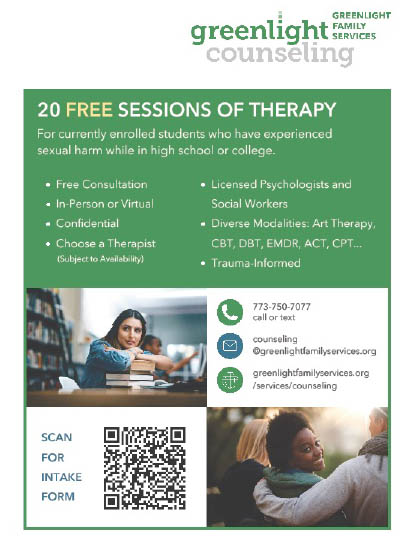
Promotional flyer for Greenlight Family Services highlighting 20 free therapy sessions for currently enrolled students who have experienced sexual harm while in high school or college.