Cougar Cares Resource Hub
The Cougar Cares Resource Hub is a one-stop resource center for students to gain access to both campus and community resources. When a student is experiencing a financial, academic, or personal stressor, a Benefits Navigator can quickly respond and link student to the supportive services needed to support their college persistence. Our Benefits Navigators are available to serve walk-in students and assist with prioritizing their needs. Providing students with a centralized location to obtain basic need support is essential to the alleviation of personal, academic, and financial stressors.
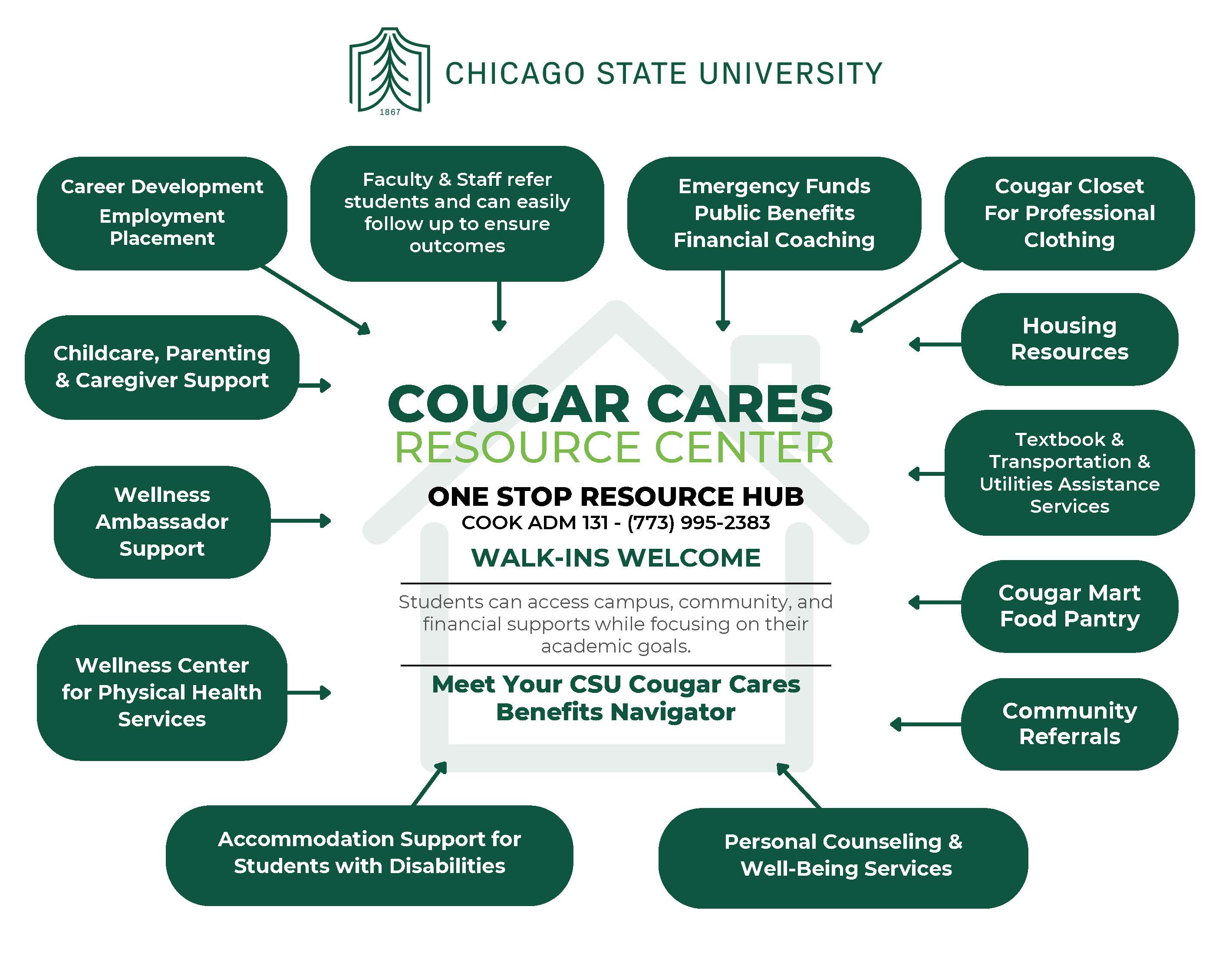
Flyer
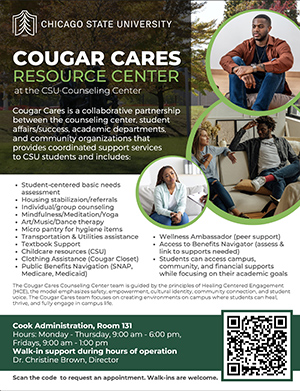
Basic Needs Insecurity
HOUSE Liaison and Resources for Housing Insecurity
The CSU Counseling Center serves as your HOUSE Liaison with Benefit Navigators that can assess needs quickly to support students as they navigate life challenges. As a result, the Cougar Cares Resource Center was created as one-stop model to support students where they are.
- Are you a CSU student who does not have safe and/or permanent housing, is struggling to pay rent, or does not have consistent access to food? You are not alone. A 2023-24 national survey found that 41% of college students experienced food insecurity, 48% of students experienced housing insecurity, and 14% had experienced homelessness in the past year. The Office of the Dean of Students is committed to assisting students who are navigating these issues.
- On this page you will find links to contact the Dean of Student’s Office and other campus support units for assistance, as well as resources (both on- and off- campus) that can provide various services and support
Source: The Hope Center 2023-2024 Student Basic Needs Survey Report . Data was collected from 74,350 students from 91 colleges and universities across 16 U.S. States.
Students Experiencing Homelessness
The Illinois Public Act 102-0083 requires all institutions of higher education to designate a staff member as the Housing and Opportunities that are Useful for Students' Excellence (HOUSE) liaison to assist homeless students enrolled in at the institution.
At Chicago State University, the individual serving as a HOUSE liaison is Dr. Christine Brown. Dr. Brown is in the Cougar Cares Counseling Center located in the Cook Administration, Room 131 and can be reached at cbrown28@csu.edu
Definition:
Unhoused and homeless students are those who do not have a fixed, regular, and adequate nighttime residence. This includes situations such as:
- Shared Housing: Living with others due to loss of housing, economic hardship, or similar reasons.
- Temporary Accommodations: Staying in motels, hotels, trailer parks, or camping grounds because of a lack of alternative adequate housing.
- Shelters: Residing in emergency or transitional shelters.
- Abandonment: Being abandoned in hospitals.
- Inadequate Nighttime Residence: Living in places not meant for regular sleeping, such as public or private spaces.
- Substandard Living Conditions: Staying in cars, parks, public spaces, abandoned buildings, bus or train stations, or similar environments.
All Students who are in need of interim housing or struggling with homelessness or housing insecurity (during academic year or academic breaks) should reach out to our HOUSE Liaison.
Internal Housing/Rental Assistance Resources
CSU Emergency Housing
Emergency Housing is available for CSU students experiencing homelessness or at imminent risk of becoming homeless. Students in crisis can access immediate, emergency housing by visiting the Cougars Cares Resource Hub located in the CSU Counseling Center, Cook Administration 131.
External Housing Resources
All Chicago = Continuum of Care Continuum of Care - All Chicago
A Continuum of Care (CoC) is a regional or local planning body mandated by the U.S. Department of Housing and Urban Development (HUD) that coordinates housing and services funding for homeless families and individuals.
Night Ministry
The Night Ministry, based in Chicago, offers housing assistance, transportation, health care, a listening ear, and food. Drop-in services are available here.
Ignite
Ignite helps unstably housed youth, ages 14-24, get their youth back and take the first step on their journey to a stable home and a future with promise. We know homelessness is not a choice, and all young people deserve to be defined by their potential, not their circumstances. https://www.ignitepromise.org
Illinois Covenant House
Covenant House Illinois provides homeless youth (ages 18-24) with ongoing care and crisis support. Drop-in services available. Covenant House IL Chicago | Support Homeless Youth
Chicago Housing Authority
Serving over 63,000 households, the Chicago Housing Authority fosters healthy communities citywide and leverages its Moving to Work designation to form innovative partnerships, expanding choices and opportunities for low-income families and individuals. Homepage | Chicago Housing Authority
Chicago Coalition for the Homeless
We organize and advocate to prevent and end homelessness because we believe housing is a human right in a just society. Chicago Coalition to End Homelessness
Housing Opportunities for Women (HOW)
Since,1983, HOW has provided permanent solutions to homelessness using the Housing First Model, offering affordable, supportive housing and individualized services. https://www.how-inc.org
Brave Space Alliance
Brave Space Alliance is the first Black-led, trans-led LGBTQ+ Center on Chicago’s South Side, providing affirming, culturally competent resources and services for LGBTQ+ individuals. https://www.bravespacealliance.org
Youth In Care
Illinois Resources
In Illinois, there are a range of support and programs to create postsecondary pathways for foster care youth. Participating in current and former foster care youth receive academic and career counseling, mentoring, life-skills training, housing support among a variety of other services. Below is a list of programs, services and supports that are actively advancing foster care for alumni through bolstering postsecondary access, retention, degree completion, and successful transition to adulthood.
Foster Progress (Y-CAP)
Based in the Chicagoland area, Foster Progress aims to increase educational attainment
among high school foster care among young people while assisting in their successful
transition to adulthood. Through mentorship, advocacy, and educational access, Foster
Progress provides supportive programs and activities to help foster youth earn a college
degree.
Foster Progress
4422 N Ravenswood Ave
Chicago, IL 60640
Email: info@foster-progress.org
Project STRIVE (Strategies to Rejuvenate Interest & Value in Education)
Targeting youth who have experienced trauma and neglect, STRIVE helps Illinois foster youth ages 14-21 transition into adulthood. In collaboration with Youth Guidance, Illinois Department of Children & Family Services (IDCFS), and Chicago Public Schools, STRIVE participants engage in social and educational enrichment field trips, college tours, and one-on-one counseling.
Project STRIVE by Youth Guidance Chicago, IL
Email: info@youth-guidance.org
Life Skills Program — Illinois Department of Children and Family Services
The Office of Education and Transition Services at the Illinois Department of Children and Family Services (IDCFS) hosts the Life Skills Program to help foster youth develop independent living skills while promoting economic and social self-sufficiency. In collaboration with IDCFS caseworkers, foster youth and caregivers create an individualized transition plan and establish time-sensitive goals for foster youth. Upon completion of the life skills program, foster youth receive a $150 stipend (IDCFS, 2020C).
Illinois Department of Children & Family Services
DCFS scholarships noted below are not accessible through filling out the FAFSA application. However, students are required to complete the FAFSA prior to applying for the noted scholarships. Please note: each program has a separate application.
DCFS post-secondary programs
Tuition and Fee Waiver Program
Tuition and fee waivers are available to a youth or former youth in care for the first five years that the youth or former youth in care is enrolled in an Illinois community college or public university so long as the youth makes satisfactory progress toward completing his or her degree. The community college or public university must waive any tuition, and fee amounts that exceed the amounts paid to the eligible student under the federal Pell Grant Program or the state’s Monetary Award Program. To apply, fill out the application and email it to DCFS.TuitionWaiver@illinois.gov along with a student schedule that includes the student’s name, school name, term and student ID number. possible as they are processed on a first come, first serve basis.
Education and Training Voucher (ETV)
This program assists youth with cost of attendance and post-secondary education related expenses not covered by financial aid grants or the DCFS Tuition and Fee Waiver. Eligible students include those in DCFS care, those who aged out of DCFS care at age 18+, or those who transitioned to adoption or guardianship from DCFS’ care at age 16+. The application is available at: apply.mykaleidoscope.com/scholarships/ILETV. The complete ETV application packet must be received prior to June 30 of the fiscal year the expense is incurred. For more information about the Education and Training Voucher program, read the ETV FAQ Sheet.
DCFS Scholarship Program
The DCFS Scholarship Program provides at least 53 scholarships each year; four of which are awarded to children of veterans. Scholarship recipients will receive a waiver of tuition and mandatory fees if they attend a local Illinois community college or state university. The application period is January through March 31 each year. For the current year’s application, email DCFS.OfficeofEducationandTransitionServices@Illinois.gov.
Youth in College Program
The Youth in College/Vocational Training (YIC/VT) Program is available to youth for whom the department is legally responsible and who are enrolled in an accredited, full-time post-secondary educational or vocational training program. Youth in this program have up to five years of eligibility or through age 25 (whichever occurs first). Youth receive a one-time start-up payment and a monthly board payment to assist with room, board and personal expenses. Full-time enrollment and a minimum term GPA of 2.0 is required.
Other post-secondary resources
- Illinois Student Assistance Commission
- Free Application for Federal Student Aid (FAFSA®)
- National Youth Transition Database (NYTD) survey
- Employment/Job Training/Apprenticeship Incentive Program (EIP)
Cougar Cares Emergency Fund
The Cougar Cares Emergency Fund provides temporary, short-term financial assistance to currently enrolled students who are unable to meet essential expenses due to a temporary or unexpected hardship. The emergency fund program is designed to offer financial assistance to students in the form on one-time awards. Emergency funds is NOT intended to provide ongoing relief for recurring expenses.
Please read before applying
In order to be eligible for this fund, you must NOT have received any emergency grants during the semester in which you are applying, and you must have already accepted all available student financial aid. Additionally, please be mindful that if eligible, students can receive this grant once per academic year.
The Cougar Cares Emergency Fund is a available for students experiencing financial constraints. Upon completing your application for the emergency fund:
- Complete the Cougar Cares Basic Needs Assessment
- Complete the Cougar Cares Emergency Funds Application
- Have supporting documentation that reflects funds equal to or less than the request. Acceptable documentation includes PDF or JPEG files only.
- Provide an itemized statement
- Bills must be from the term of the application and must be current
- You must be a registered student during the semester you are applying for this fund.
**Please note bank statements and credit card statements will NOT be reviewed as documentation. Additionally, any application that does not include the above steps will be considered incomplete and will NOT be accepted. **
Applications will be accepted during Fall and Spring terms. Applications will be accepted if funds are available and are processed on a first-come/first- serve basis.
Applications will not be accepted during breaks.
| Expenses Considered (proof required) |
| Rental Assistance with proof of eviction notice or notice of late rent |
| Late utility bills with proof |
| Emergency childcare assistance |
| Transportation assistance (students that reside in suburban areas) |
| Textbook/learning platform expense |
| Change in employment status or loss of income |
| Death of a parent/partner/spouse/child |
| Replacement of belongings lost in a fire or natural disaster |
| Expenses Not Considered |
| Tuition and fees |
| Campus Housing costs |
| Health insurance |
| Credit card expenses |
| Parking tickets and other fines |
| Costs for entertainment, recreation and wellbeing, and non-emergency travel |
| Medical bills for any person other than the student applying |
| Other non-essential expenses (i.e. cable bill, cell phone bill, parking fees) |
Applications for the Cougar Cares Emergency Fund can be submitted here.
Cougar Cares Basic Needs Screening
Apply for the Cougar Cares Emergency Fund
Food Insecurity
Food insecurity is a serious and widespread issue in Chicago, affecting thousands of individuals and families. Contributing factors include poverty, limited access to fresh and affordable food, particularly in areas known as "food deserts," and the lingering economic effects of the pandemic. But hope and help are available.
Government programs like SNAP and WIC offer critical assistance to those in need, helping cover the cost of groceries and nutrition for families, women, and children. Community-based organizations such as Nourishing Hope and the Greater Chicago Food Depository are also on the front lines, distributing food, raising awareness, and advocating for long-term solutions.
At Chicago State University, we are committed to helping students navigate food insecurity. Through the Cougar Cares Food Pantry, students can access groceries directly on campus. The Cougar Cares Resource Hub at the CSU Counseling Center.
Cougar Cares Food Pantry
The Cougar Cares Food Pantry provides free, confidential access to nutritious food for currently enrolled students experiencing food insecurity. The goal is to ensure that no student must choose between purchasing food an meeting their educational expenses. The CSU Food Pantry offers a variety of shelf-stable items, fresh foods, beverages, and personal care essentials to support students’ health, well-being, and academic success.
How to access the Cougar Cares Pantry:
Cordell Reed Student Union Building
Contact the Dean of Students
Phone: (773) 995-3973
Cougar Closet
The Cougar Closet is a free campus resource that provides students with access to clean, gently used, and new clothing in a welcoming, confidential, and judgement-free environment. When you need professional attire for an interview, business casual clothing for class presentation and internships. Students may visit the Cougar Closet by appointment.
Contact the Career Development Center
Cordell Reed Student Union, Room 268
Phone: (773) 995-2327
Child Development Laboratory School
At the CSU Child Development Laboratory School, located on the campus of Chicago State University, we’re dedicated to providing exceptional early childhood education for children. Our pre-K program is designed to foster a love for learning in a supportive and engaging environment.
Contact the Child Development Laboratory School
Education Building, Room 107
Phone: (773) 995-2585
Wellness Center
Provides primary health services for CSU students and is a comprehensive health and educational resource for the entire campus community. Our center is directed by a full-time Family Nurse Practitioner and assisted by support staff consisting of physicians, registered nurses and other health professionals.
The Wellness/Health Center works with CSU’s College of Health Sciences to increase health care access to the campus community. We encourage students, faculty and staff in developing and maintaining healthy lifestyles.
Contact Us:
Location: Cook ADM, Room 130
By Appointment only
No walk-ins
 ©
Chicago State University
©
Chicago State University  All Rights Reserved
 (773) 995-2000