As quantum’s presence grows on the southeast side, Chicago State University students eye future careers
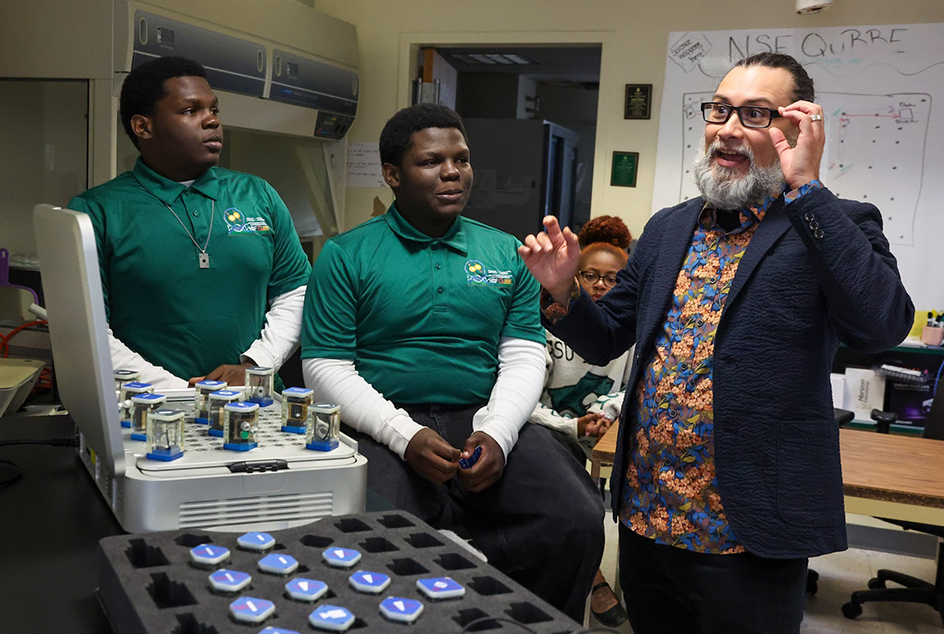
In hushed voices in a darkened room, John and James Kountz stared intently at what looked to any unsuspecting person like a computer screen inside a metal suitcase. The identical twins in matching forest-green shirts leaned in and watched as two frequencies created hills and valleys on the screen of the Quantenkoffer, a $250,000 quantum optics laboratory machine housed in Chicago State University’s Quantum Education, Science & Technology Center, as they searched for the smallest discrepancies in the data.
Other college freshmen might be outside soaking up the nice weather on this sunny September day. But for the Kountz twins, both pursuing an engineering physics degree, being nestled inside the CSU quantum center is the best place to be, a second home where they can get hands-on experience with quantum physics, biology and more.
It’s a career path the engineering physics majors didn’t envision when they first started learning about science and engineering, but one that has become a passion, growing by the day as they begin their college years.
And while quantum is often associated with the Illinois Quantum and Microelectronics Park, the $9 billion, 440-acre development under way at the former U.S. Steel South Works site, CSU was staking its claim in the field nearly a decade ago — years before the development composed of businesses, tech firms, researchers, manufacturers and quantum companies led the Southeast Side to be dubbed the “future of quantum."
Pentagon Will Partner With Five Universities to Create New Corps of Cadets
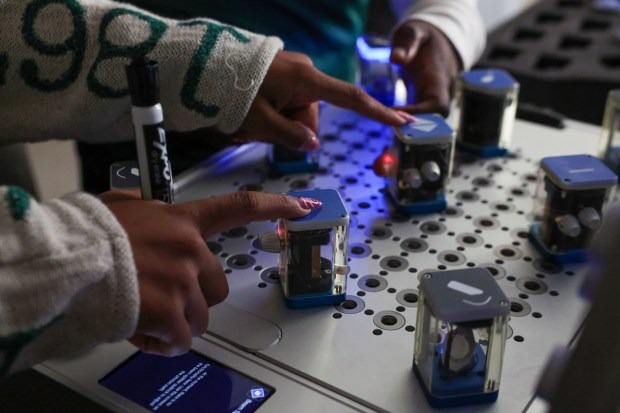
Student Nmari Ward work on a quantum optics laboratory contained in a suitcase called the Quantenkoffer at the Quantum Education, Science & Technology Center at Chicago State University on Sept. 22, 2026. (Stacey Wescott/Chicago Tribune)
Inside the CSU quantum lab, the twins use the Quantenkoffer to measure subatomic particles, watching for signs they exist in the same quantum state at the same time.
The chance to get up close with data, experiments, and technology so early in their college careers drew both twins to CSU, especially after growing up in the city’s Austin neighborhood, John Kountz said.
“It’s beautiful, because you’ve got normal kids [here] and we’ve never seen ourselves in this position, especially at our age,” John Kountz said of himself and his brother doing research in the lab. “We were like, we’re going to be 50 when we get to this level, but here we are.”
The two brothers had always been creative and curious, with a shared desire to be engineers, they told the Tribune between experiments on Sept. 22. It wasn’t until their high school physics teacher introduced them to the world of quantum that they considered how it could pair with engineering. From there, they were enamored with the subject.
For James Kountz, CSU was a natural choice to further his interest in quantum and his career. It’s been hard for him to wrap his head around all the strides he and his brother have made in the quantum world over the last few years. They’ve taken international trips, learned from local scientists including at Fermilab, and volunteered to teach quantum at CSU over the summer before they were even students after being invited by the university’s Assistant Professor of (Quantum) Physics, Russell Ceballos.
“I always wanted to be in a lab…we wanted to be engineers at six,” James Kountz said, adding that he would see pictures and videos of scientists growing up but didn’t know if that life was fully attainable. “You think, man, they must be geniuses…that’s how it felt to us. So us being in the labs now, looking back, it’s like we’re meeting up with our childhood goals. That’s the most exciting thing.”
Only weeks into the semester, the two brothers are known on campus, too, getting greeted by “what’s up twins” from passersby. While it’s nice to be recognized for their presence in the quantum community, it has carried some weight, too. Multiple people have told the twins that they are role models and a symbol that quantum can be a space for anyone, no matter their background, John Kountz said. “We know people are watching us, so we gotta be trying as hard as we can…people look up to us,” John Kountz said. “We represent a lot of people, whether we know it or not.”
Still, the twins have four years to go before graduation. Afterward, they have plenty of options: they could return to CSU to earn a certificate in quantum, start a business or further their education elsewhere. But for the next few years, they plan to be heads down in research, learning as much as they can before entering the workforce.
“We definitely want to try to do a business. We want to do something in the quantum field, like make the materials for quantum machines [and] quantum technology,” John Kountz said.
‘A good foundation’: CSU’s quantum impact already felt
CSU’s presence in the quantum field has grown since it began exploring it in 2017, according to Valerie Goss, a chemistry professor at CSU and director of the quantum center. Goss has seen quantum technology blossom and improve since research began, building on existing science to create new ways to explore computing practices and other analyses.
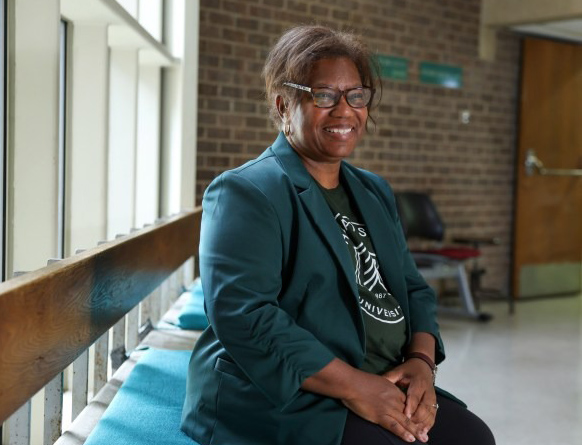
Valerie Goss, professor of chemistry and director of Quantum Education, Science & Technology Center at Chicago State University on Sept. 22, 2026. (Stacey Wescott/Chicago Tribune)
The field is more accessible than it was a decade ago, Goss said, adding that there’s space for everybody in quantum now, with more Black and Brown people involved than before.
“Quantum is not just for people who are doing the hard science, it’s the people from history, business, pharmacy, all these different disciplines…everybody can come into this field,” Goss said. “Where there were a few voices, now there are many, and they’re coming from all areas of the city and the region.”
That access has expanded over the years with the CSU offering both a minor and certificates in quantum technology, and providing research opportunities like the quantum lab.
CSU is also a part of a National Science Foundation program called Quantum Leap Challenge Institute for Quantum Sensing for Biophysics and Bioengineering (QuBBE), where students aim to create new ways to use quantum measurements in biology and foster their quantum workforce skills through STEM education. Even before entering college, K-12 students can attend programs to learn about quantum.
These opportunities are what draw students interested in quantum to CSU and the city’s South Side, Goss said, adding that the students are their motivation and “driving force.” Advancing the school and the field means partnering more strongly with quantum industry partners and protecting the opportunities students already have, like internships and jobs.
“We want to be drivers of new knowledge in the fields,” Goss said, which attracts students. It’s a match because the students want to do research at the undergraduate and graduate level, and that’s where CSU aims to make inroads. CSU is doing its best, Goss said, to ensure those research opportunities move forward.
Those opportunities include the high-profile Illinois Quantum and Microelectronics Park, or “quantum park,” just 5 miles away from CSU’s campus. The university’s strong foundation in the field positions it as an industry leader in the Chicago area, according to the park’s workforce development lead, Emily Whitman Easton. And CSU creates a “hyperlocal opportunity” for people on the South and Southeast Sides to train and advance a quantum career if they choose to.
“If we are looking to build a technology workforce that does not repeat the same mistakes of the past, an institution like Chicago State – who is a trusted educational partner which is a predominantly Black institution – taking a leadership role here is a huge step forward in how we can build an inclusive tech economy in a way that literally doesn’t look like the other economies we’ve seen,” Whitman Easton said.
Those roles can span from technical quantum computing positions to human resources or business analytics. Through its wide program offerings, CSU is preparing all students to enter a workforce where quantum is growing and showing that the field has places for people on the southeast side, Whitman Easton said.
“Chicago State, by helping us develop a quantum literate community, is just serving so many workforce needs in a field that people might not have considered themselves a part of,” Whitman Easton said.
The students at both the undergraduate and graduate levels can feel the program’s uniqueness, too. For graduate student Dell-Rio Johnson, 22, who has a background in computer science but came to the university to pursue the quantum certificate and start research in the lab over the summer, CSU’s offerings add more skills to the field he already knows.
“I think it’s a good foundation for you to jump into any avenue of quantum,” Johnson said, adding that he could see himself pursuing a job in the Chicagoland area or adapting elsewhere. “I’m open to anything really. As much as I can learn and as much experience as I can get [that’s] hands on…it’s definitely, I feel like, the best place to get a starter foundation and other opportunities.”
 ©
Chicago State University
©
Chicago State University  All Rights Reserved
 (773) 995-2000