The Chairman Returns
In Measure of a Man, Fred Hampton gets the final word – by Kerry Reid
Two years ago, Chicago playwright India Nicole Burton’s Panther Women at Perceptions Theatre paid tribute to the women in the Black Panther Party. For Measure of a Man, Burton turns to Fred Hampton, the chairman of the Illinois chapter, who was assassinated by Chicago police in 1969 at 21 as he slept.
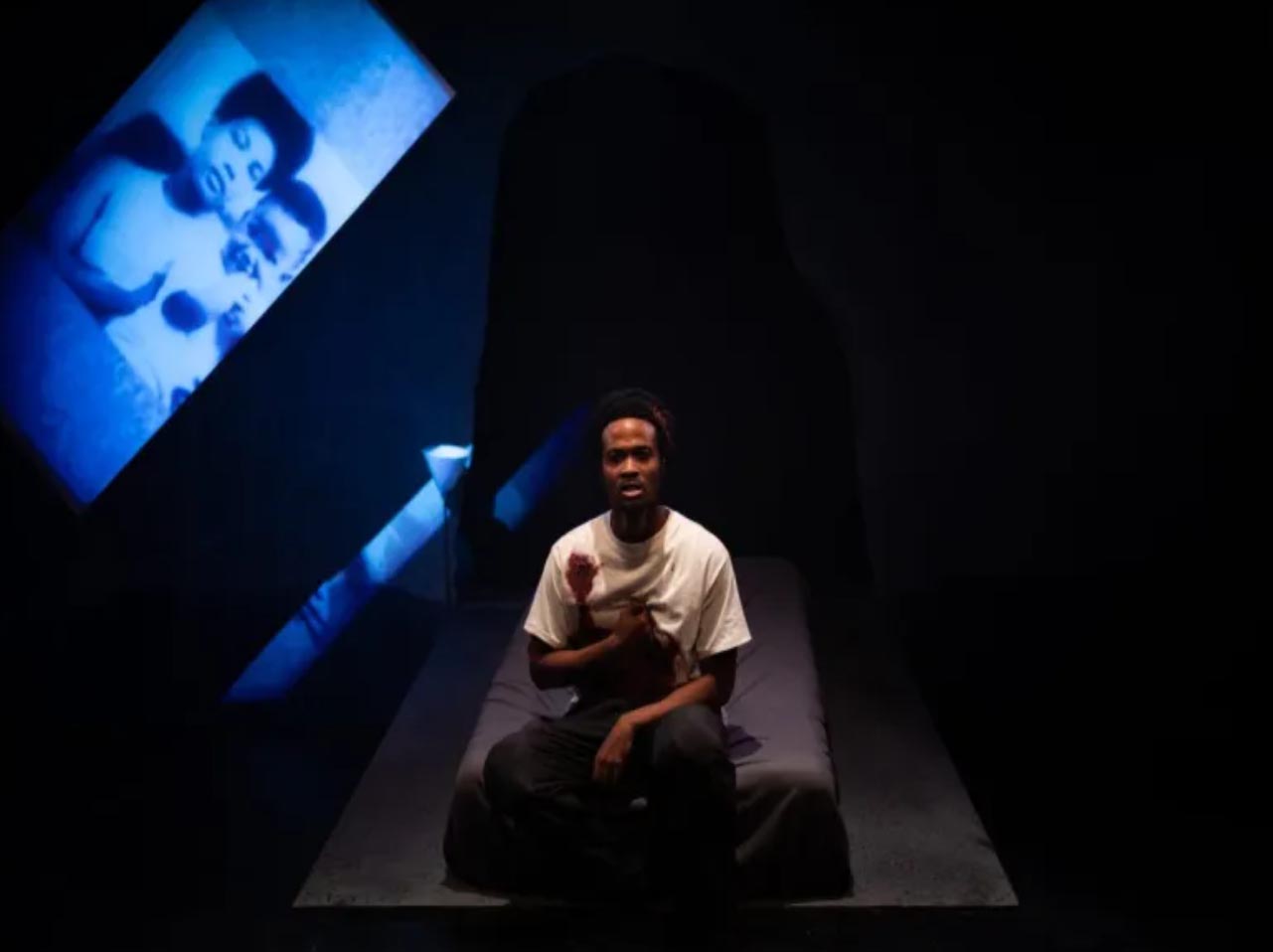
Demorris Burrows as Fred Hampton in India Nicole Burton's Measure of a Man with Coalescence Theatre. Credit: Erin B.
Measure of a Man, produced by Coalescence Theatre and directed by ILesa Duncan, doesn’t offer a straightforward biodrama about Hampton. Instead, Demorris Burrows as Hampton takes us on a powerful collage-like journey through Hampton’s story as being representative of racism and revolution in the U.S. When we enter the theater, Burrows is stretched out facedown on a mattress onstage, a large bloodstain visible on his T-shirt. When he arises (revealing more blood on the front), he seems unsure where he is. Limbo? An alternate universe? No matter. There’s still work to be done. Burton’s play clearly aims for us to see Hampton’s life and activism, not just his martyrdom, as the key to understanding him and the mission of the Panthers and other revolutionaries.
Through a series of sharp vignettes encompassing everything from an imaginary boxing match to a sardonic game show, Hampton reminds us of the deeply ingrained and entwined injustices of capitalism and racism that built our nation. The audience is asked to join in chants, answer quiz questions, and go through the Panther ten-point program, or “bill of rights.” The message that “nothing is more important than stopping fascism, because fascism is gonna stop us all” couldn’t be more timely. Through it all, Burrows dons a series of different jackets—each marked with a small bullet hole, like a gruesome corsage.
But while this is most certainly a political call to action, it’s also, as was Burton’s earlier piece, suffused with tenderness about the sacrifices and pain involved in truly committing to the fight for justice. One of the most heartrending parts is when Hampton tries to imagine what his unborn son, who was in utero with his mother next to him in bed when the deadly raid started, might have absorbed in those terrifying moments. His memories of the murder of Emmett Till also remind us that living under the threat of white supremacist violence has long been a feature, not a bug, for many Black citizens.
Burrows’s performance is charismatic and multilayered, drawing at times upon the rhetorical gifts for which Hampton was so noted, and at other times on an easygoing rapport with the audience. And though there is justifiable anger, there is also a palpable sense of the joy that can come with having a vision larger than your own life. “If you walk through life and you haven’t helped anyone, you haven’t had much of a life,” Burrows’s Hampton tells us. That truly is the measure of this man’s life, but also a yardstick for building our own resistance in these authoritarian times.
 ©
Chicago State University
©
Chicago State University  All Rights Reserved
 (773) 995-2000