Faculty - Dr. Russell R. Ceballos
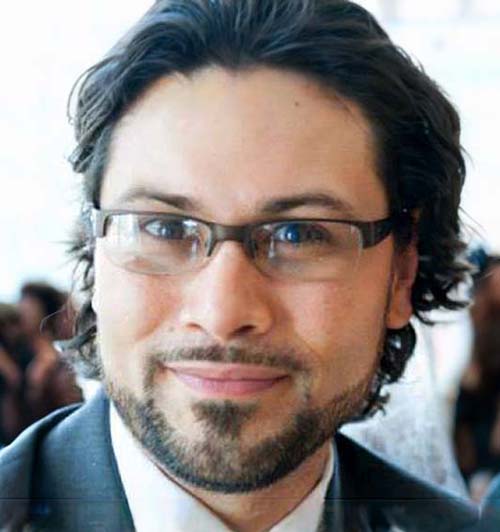
Assistant Professor of (Quantum) Physics
|
||||
|
Publications
- Abu-Nada, A., Ceballos, R. R., and Wu, L. A. Detecting Initial System-Environment Correlations from a Single Observable. arXiv:2602.18516v1 [quant-ph]. Submitted to Physical Review A. (2026). https://doi.org/10.48550/arXiv.2602.18516
- Abu-Nada, A., Ceballos, R. R., Aryan, I. Hybrid Predictive Quantum Feedback: Extending Qubit Lifetimes Beyond the Wiseman–Milburn Limit. IEEE – Quantum Communications, Networking, and Computing (QCNC). arXiv:2511.13774v3 [quant-ph]. eCF Paper Id: 1771270102767. (2026). https://doi.org/10.48550/arXiv.2511.13774
- Ceballos, R. R.,et. al. Machine Learning-Enhanced Validation of Entanglement Distribution over Quantum Networks (QTh3A.3). Scottish Event Campus, Glasgow, UK. Quantum 2.0 (2026).
- Espiritu, D. J., & Ceballos, R. R., & Todorovic, R. (2025, June). Bridging Gaps and Building Pathways to Increase Transfer through Data-Driven, Innovative, and Evidence-Based Strategies at Community College Paper presented at 2025 ASEE Annual Conference & Exposition , Montreal, Quebec, Canada . 10.18260/1-2—56009
- Ceballos, R. R.,et. al. Evaluation of Quantum Entanglement Using SeQUeNCe via the CHSH Game. Workshop on Quantum Network Simulations. IEEE QCE24, Montreal, Quebec, CA. (2024).
- Ceballos, R. R.,et. al. Building Scalable and Certifiable Protocols for Entanglement Routing Over Noisy Quantum Networks. UEI Number: L7KBLCN4YJX9. Air Force Research Laboratory. (2024).
- Ceballos, R. R.,et. al. Prototyping a Modular Photonic Quantum Network Testbed with Embedded Memory. UEI Number: L7KBLCN4YJX9. Air Force Research Laboratory. (2024).
- Barnes, E., Bennett, M.B., Boltasseva, A.et al. Outcomes from a workshop on a national center for quantum education. EPJ Quantum Technol. 12, 40 (2025). https://doi.org/10.1140/epjqt/s40507-025-00343-4
- Chung, G. Kanter, N. Lauk, R. Valivarthi, W. Wu, R. R. Ceballos, C. Pena, N. Sinclair, J. Thomas, S. Xie, R. Kettimuthu, P. Kumar, P. Spentzouris, and M. Spiropulu. Illinois Express Quantum Network (IEQNET): Metropolitan-scale experimental quantum networking over deployed optical fiber. Proc. SPIE 11726, Quantum Information Science, Sensing, and Computation XIII, 1172602 (2021).
- R. R. Ceballos,G-Consistent Subsets and Reduced Dynamical Quantum Maps. (2017). https://ui.adsabs.harvard.edu/abs/2017PhDT.......135C
- M. Byrd, R. Ceballos and E. Chitambar. Open system quantum evolution and the assumption of complete positivity (A Tutorial), “International Journal of Quantum Information 14, 1640023 (2016).
- E. Chitambar, A. Abu-Nada, R. R. Ceballos and M. Byrd.Restrictions on initial system-environment correlations based on the dynamics of an open quantum system. Physical Review A 92, 052110 (2015). doi:10.1103/PhysRevA.92.052110
- N. Zuniga-Hansen, R. Ceballos and M. S. Byrd, "Role of the different factors contributing to long lived quantum coherence in the FMO complex,” APS March Meeting, Z46.012 (2013).
- Ceballos, R. R., Kafatos, M., Roy, S., and Yang, S. “Quantum mechanical implications for mind-body issues,” Quantum Mind Conference, G. Bemoider (ed) Univ. Salzburg (2007).
- Ceballos, R. R. “Synchronous Oscillations and Phase Encoding in the Brain,” Quantum Mind – Consciousness, Quantum Physics, and The Brain Conference, Tucson, Arizona (Mar. 2003).
Peer Reviewer
- 2024 – NSF HBCU-UP TIP Directorate Grant Proposal Review Panel
Research
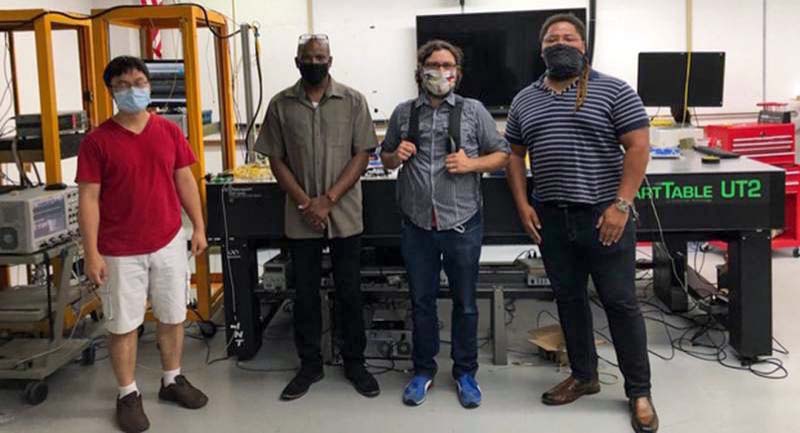
- Quantum Communication Networks: Was Co-PI on a Department of Energy grant supervising helping to commission new quantum network nodes as a part of the “Illinois-Express Quantum Network“ (IEQNET) project for the advancement of quantum communication networks and the quantum internet, while supervising 8 CSU students for the project. The IEQNET research project aims to architect, develop and demonstrate complex network topologies and hybrid quantum-classical information shuttling protocols on a metropolitan-scale transparent optical quantum network. The intended sites to be linked are located at i) the Northwestern University Evanston campus, ii) Northwestern memorial medical school campus in downtown Chicago, and Fermi National Laboratory (Fermilab) in Batavia, Illinois. Fermilab has already developed a 3-node scalable optical quantum network called Fermilab Quantum NETwork, established in 2017) which is currently being extended to include additional remote nodes, approximately 3 km apart, at a new lab within the Fermilab site.
- As part of this project, undergraduate students at CSU will be learning how to program Field-Programmable Gate Array (FPGA) circuit-boards in order to help program the network control functions, as well as learn how to use the quantum optics equipment at CSU and Fermilab to prepare them for more advanced research at other collaborating institutions, such as Fermilab, the University of Chicago, Northwestern University, the University of Pittsburgh, Carnegie Mellon University, the University of Wisconsin-Madison, and the University of Illinois at Urbana-Champaign, see for more details:
$25 million Quantum Information Institute
- Coupling Quantum Dots and Quantum Wires: External Member of the Pittsburgh Quantum Institute (PQI) as a theoretical research scientist helping to characterize coupling mechanisms between silicon quantum dots and various 2-D quantum materials for the purpose of a.) reliably reproducing scalable, error-free integrated quantum computer chips and for b.) reliably interconnecting qubits via electron waveguides using these state-of-the-art silicon quantum dots that are capable of being put into commercial production.
- Theory of Open Quantum Systems: Worked as a part of a team investigating the physical conditions and limitations therein imposed on open quantum systems when using completely positive reduced dynamical quantum maps. The goal was to determine which classes of global unitary operators (acting on the total system- environment space), along with which types of system-environment correlations, lead to novel mechanisms for the witnessing of entanglement.
- Quantum Biophysics (a): Quantum Coherent Dynamics of Green Fluorescent Protein: I previously worked with Dr. Prem Kumar to develop a theoretical model for the coherent quantum dynamics of enhanced Green Fluorescent Protein (EGFP) for a.) the generation of entangled photon states and the direct application of quantum communication techniques to fluorescent protein-pigment systems, as well as for biomimetic quantum sensing.
- Quantum Biophysics (b): Worked with a research group at the Pittsburgh Quantum Institute to investigate the possibility of utilizing the inherent spin-orbit coupling in certain chiral biomolecules, proteins, and oxides to achieve quantum transport in these systems for the fabrication of novel quantum devices using self-assembled DNA origami nanostructures as molecular scaffolding.
- Quantum Biophysics (c): Contributed to the investigation of the quantum coherent nature thought to underly exciton transfer in the Fenna-Mathews-Olson photosynthetic pigment-protein complex, as well as performed theoretical research investigating the quantum mechanical nature of K+ ion-channels.
Quantum Game Theory for Quantum Networks:
- “Evaluation of Quantum Entanglement Using SeQUeNCe via the CHSH Game,” Workshop on Quantum Network Simulations In Conjunction with the IEEE QCE24 Conference, Montreal, Quebec, CA, David McDermott, Amir Khannejad, Zizwe A. Chase, Thomas A. Searles, and Russell R. Ceballos
- This project if focused on performing quantum network simulations using the Python-based SeQUeNCe programming package to investigate quantum entanglement distribution over quantum networks.
As Co-PI, Dr. Ceballos helped lead the incorporation of a national non- profit organization, QuSTEAM, serving a network of academic institutions and industry employers. Our purpose is to facilitate the national scale-up of equitable and effective undergraduate quantum education by building and supporting a collaborative network of academic institutions, private sector employers, and a community of instructors. QuSTEAM helps the quantum education community disseminate, research, curate, and deliver instructional content using methods that engage students and promote equity. We facilitate and promote campus-industry connections and campus-campus QISE collaboration. Dr. Ceballos has led the research and development effort to establish a minor in QISE at accredited US institutions and is currently in the process of consulting with a number of institutions to adopt QuSTEAM materials and join our network.
Curriculum Development
Quantum Machine Learning, INA Solutions, Inc. has been awarded almost $1 million from the U.S. National Science Foundation to lead a national research effort enabling experiential learning in quantum machine learning (Award #2347101). The goal is to build a diverse workforce with confidence and literacy in the next wave of technologies. The cooperative agreement will support a three-year project that will grow in scale as it progresses, particularly as quantum computing is becoming essential in new and emerging technologies, science, and business.
Russell R. Ceballos is serving as Curriculum Development Lead and Lead Instructor to create a 6-week online undergraduate certification course in Quantum Computing and Quantum Machine Learning using Python programming language focused on bringing minoritized communities, particularly from community colleges, across the country into the field of Quantum Information Science and Engineering (QISE). This award is part of NSF's Experiential Learning for Emerging and Novel Technologies (ExLENT) program. ExLENT offers pathways for people with varying science, technology, engineering, and mathematics (STEM) experience levels.
QuSTEAM Initiative (SLIDE DECK):
As co-PI, Curriculum Development Lead, and Director of Innovation and Programs, Dr. Russell R. Ceballos has help lead the incorporation of QuSTEAM (an NSF-funded national non-profit organization that was successfully incorporated as part of NSF’s National Convergent Accelerator Program). QuSTEAM, serving a network of academic institutions and industry employers, started with five educational institutions in 2020 and now has grown to over 50 educational institutions and over 40 companies (e.g. JP Morgan & Chase, IBM, Infleqtion, SandboxAQ, QURECA).
QuSTEAM’s mission is to facilitate the national scale-up of equitable and effective undergraduate quantum education by building and supporting a collaborative network of academic institutions, private sector employers, and a community of instructors. QuSTEAM helps the quantum education community disseminate, research, curate, and deliver instructional content using methods that engage students and promote equity. We facilitate and promote campus-industry connections and campus-campus QISE collaboration. Russell R. Ceballos led the effort to design
Curriculum Development
Quantum Machine Learning, INA Solutions, Inc. has been awarded almost $1 million from the U.S. National Science Foundation to lead a national research effort enabling experiential learning in quantum machine learning (Award #2347101). The goal is to build a diverse workforce with confidence and literacy in the next wave of technologies. The cooperative agreement will support a three-year project that will grow in scale as it progresses, particularly as quantum computing is becoming essential in new and emerging technologies, science, and business.
Russell R. Ceballos is serving as Curriculum Development Lead and Lead Instructor
to create a 6-week online undergraduate certification course in Quantum Computing
and Quantum Machine Learning using Python programming language focused on bringing
minoritized communities, particularly from community colleges, across the country
into the field of Quantum Information Science and Engineering (QISE). This award
is part of NSF's Experiential Learning for Emerging and Novel Technologies (ExLENT) program. ExLENT offers pathways for people with varying science, technology, engineering,
and mathematics (STEM) experience levels.
QuSTEAM Initiative (SLIDE DECK):As co-PI, Curriculum Development Lead, and Director of Innovation and Programs, Dr. Russell R. Ceballos has help lead the incorporation of QuSTEAM (an NSF-funded national non-profit organization that was successfully incorporated as part of NSF’s National Convergent Accelerator Program). QuSTEAM, serving a network of academic institutions and industry employers, started with five educational institutions in 2020 and now has grown to over 50 educational institutions and over 40 companies (e.g. JP Morgan & Chase, IBM, Infleqtion, SandboxAQ, QURECA).
QuSTEAM’s mission is to facilitate the national scale-up of equitable and effective undergraduate quantum education by building and supporting a collaborative network of academic institutions, private sector employers, and a community of instructors. QuSTEAM helps the quantum education community disseminate, research, curate, and deliver instructional content using methods that engage students and promote equity. We facilitate and promote campus-industry connections and campus-campus QISE collaboration. Russell R. Ceballos led the effort to design and implement a minor in QISE and is currently in the process of consulting with several institutions to adopt QuSTEAM materials and join our network. Dr. Ceballos has helps develop curriculum, along with assessment strategies, for introductory undergraduate Quantum Information Science and Engineering (QISE) courses, as well as helps further develop advanced undergraduate quantum optics laboratory courses across the nation, as well as establish a new Quantum Information Science concentration track within the Physics Bachelor's degree program at Chicago State University. Responsibilities included course, laboratory, and research program development. Artificial Intelligence – SandboxAQ: Invited to help lead the curriculum development effort as NYU and SandboxAQ partnered together to form a new quantum undergraduate degree program that is designed to highlight current workforce opportunities available for quantum engineers, share best practices and models from existing undergraduate programs in quantum technology (QT), guide faculty and administrators in identifying and addressing barriers to success for a QT minor degree program, and support participants in designing their program. Ultimately, NYU educators will incorporate insights gained throughout the workshop, the strengths of the existing major degree programs and resources, and the university's mission to make Tandon’s undergraduate Quantum Technology Minor a leading program to educate tomorrow's quantum workforce. This partnership with NYU is part of SandboxAQ's educational outreach program, which includes university partnerships and student residencies. The program aims to foster collaboration between the private sector and academia to build a quantum future that everyone can benefit from.
Chicago State University – Quantum Computing:
Developed curriculum for and taught introductions to quantum computing, quantum optics, and how quantum optics can be used to develop quantum computers through hand-on-labs (Quantenkoffer, Qutools) that can be integrated into existing courses in a modular framework. Russell R. Ceballos also developed and taught a quantum computing course, as well as worked with Dr. Jan-Jo Chen to help develop curriculum and courses for quantum computing and quantum machine learning offered through the Computer Science Department at Chicago State University. This course waived all pre-requisites (e.g. biology majors enrolled), introduced students to a.) the field of quantum information science and engineering (QISE), b.) the basics of programming in Python, c.) the fundamentals of quantum computing, d.) the current limitations of quantum devices due to quantum noise and decoherence, as well as e.) Grover’s quantum search algorithm.
Additionally, I have trained students from all backgrounds and background-types (including HS students) to run programs and algorithms on actual quantum processing devices accessible to me via the cloud as part of a partnership with qBraid (a Chicago-based quantum startup company) and QuSTEAM (an NSF funded non-profit organization I helped spin up and for which I serve as Curriculum Development Lead, as well as Director of Programs and Innovation, and our mission is to expand access to quantum educational programs across the nation).
Chicago State University – Quantum Optics Laboratory:
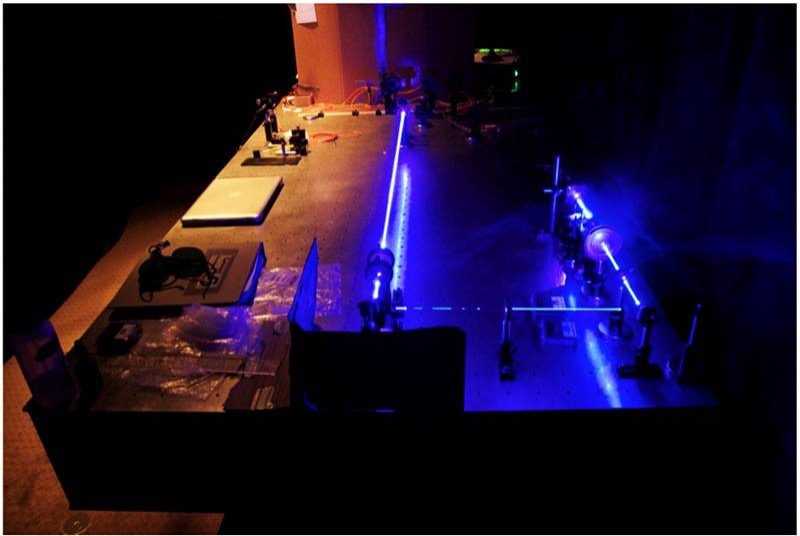
Developed a laboratory and curriculum for quantum optics modules as part of the Advanced Physics Laboratory Course in the Physics Department, and was the Thesis advisor for multiple undergraduate students working in a quantum optics laboratory equipped with a 5’x3' optical breadboard, nanosecond pulsed lasers, BBO crystals, polarizing beam splitters, noise isolating optical breadboard legs, quarter and half-wave plates, as well as single-photon avalanche photodiode detectors to perform fundamental tests of quantum mechanics using photons. These experiments include the demonstration of single-photon interference, delayed-choice quantum eraser, EPR steering, entanglement witness measurements, as well as experimental tests of non-local realism.
Contributed Research Presentations
SEP 2024 – “Evaluation of Quantum Entanglement Using SeQUeNCe via the CHSH Game,” Workshop on Quantum Network Simulations In Conjunction with the IEEE QCE24 Conference, Montreal, Quebec, CA
- David McDermott, Amir Khannejad, Zizwe A. Chase, Thomas A. Searles, and Russell R. Ceballos
NOV 2023 – NSF QuBBE: Enhancing Quantum Information Science and Technology through Workforce Development among underrepresented communities on the South Side of Chicago. Fermi Quantum Garage, Fermi National Laboratory, Batavia, IL
- Paul Agyebo-Gilberts, Jacqueline Stevens, Russell R. Ceballos, Valerie Goss, Archie Peters
Muriel Mcclendon, John Peters, Mel Sabella, Austin Harton, and Russell R. Ceballos
Invited Presentations
AUG 2024 – Keynote Speaker: i.c.stars iOpener Innovation Conference: Emerging Innovations in Data Analytics & Artificial Intelligence (Slide Deck), Blue Cross Blue Shield Tower, Chicago, IL
- New trends in generative AI as well as insights on monetizing, democratizing and fully leveraging your data. Listen to engaging keynote speakers, participate in CIO-led breakout discussions, and network with tech leaders and i.c.stars alumni.
- Achieving Transformation through AI for the field of Quantum Information Science and Engineering. (Slide Deck) Russell R. Ceballos, Ph.D., will speak about how Generative Artificial Intelligence (AI) can help transform society through the field of Quantum Information Science and Engineering (QISE) by enhancing translational research and development leading to commercial quantum technologies, as well as accelerating the development of a well-trained quantum-ready workforce in the most inclusive and equitable manner. His talk will feature his work with QuSTEAM and industry partners to establish an inclusive AI-Teaching Assistant trained on QuSTEAM created materials that employ cutting-edge culturally relevant pedagogical best-practices for the field of QISE in order to help broaden participation in the field.
JUL 2024 – Quantum Social Science Bootcamp IV, The Ohio State University, Columbus, OHo The hypothesis, or wager, behind quantum social science is that the human mind and behavior are more like the indeterminate and entangled sub-atomic phenomena described by quantum physics than they are like the deterministic inanimate objects described by classical mechanics. Yet, a century after the quantum revolution, the classical mechanistic worldview remains deeply baked into the ontology and methodology of the social sciences. Consider that every time we reach for probability theory in our work, social scientists are almost certainly – and probably unconsciously – reaching for classical probability theory, not its quantum cousin.
- “QuSTEAM: Transforming Science Through Better Education” with Russell R. Ceballos, Ph.D.
JUN 2024 – QuBBE Biosensing HS Summer Program, Chicago State University, Chicago, ILo This two-week summer camp introduced students to various pathways in the quantum information science and engineering
(QISE) workforce. Campers will learn hands-on laboratory skills needed for research
activities in quantum optics, quantum computing, and general laboratory practices
required for all STEM students.
MAY 2024 – Wolfram Alpha Research and Innovation Team Podcast (VIDEO LINK), Wolfram, Champaign, IL
- The academic innovation team hosts a discussion about ongoing efforts by QuSTEAM. They are joined by Russell R. Ceballos, Ph.D., Director of Innovation and Programs at QuSTEAM and Associate Director of Curriculum & Education Partnerships at the Chicago Quantum Exchange, along with Bennet Brown, Executive Director of QuSTEAM.
MAR 2024 – Keynote Speaker: Electrical and Computer Engineering Seminar Series, College of Engineering, University of Illinois – Chicago, Chicago, IL
- Curious About Quantum? (Part 2) In this second installment of the series, “Curious About Quantum,” Dr. Ceballos will revisit the basic concept of quantum entanglement in the context of the CHSH game as an introduction to a discussion of his current work as a quantum educator at the Chicago Quantum Exchange, as he develops innovative examples leveraging game theory, game design theory, as well as culturally relevant and responsive pedagogical best practices at the undergraduate level to help foster a culture of inclusivity and an authentic sense of belonging in the field of Quantum Information Science and Engineering (QISE) at large, particularly for students from historically minoritized communities. Dr. Ceballos will also discuss his previous work in the areas of open quantum systems and quantum biology, time permitting.
JUL 2023 – NSF Workshops: Supporting Minority Serving Institutions in the Creation of a Diverse, Quantum-Ready Workforce, University of District Columbia, Washington, DC
- The 2018 National Quantum Initiative Act recognized the importance of strategic, federally coordinated support for quantum information science and engineering (QISE) research to maintain economic competitiveness, sustain national security, and fuel transformative scientific advancement. This immediately accelerated the pace of an already rapidly advancing field and, consequently, surged the demands for trained quantum engineers.
- Sessions include:
- industry opportunities in QISE,
- educational resources (including experimental toolkits) to assist with starting new courses,
- new educational QISE programs, and QISE funding opportunities for MSIs and PUIs.
- Russell R. Ceballos will speak on, “How the Rapid Development of the Field of QISE Provides an Opportunity for Novel Academic-Industry-Government Engagement and Partnerships”
JUL 2023 – Qû’23 QuSTEAM Summer Summit and Workshops, Argonne National Laboratory, Advanced Photon Source Conference Facility
- Russell R. Ceballos, Planning Committee – The Qû’23 QuSTEAM Summer Summit and Workshops offers workshop topics from Campus-to-Company in QIS to Active Learning in QISE Instruction. This conference aims to serve existing QuSTEAM team members as well as the wider community of faculty and industry leaders engaging undergraduates in QISE education and research. Faculty in adjacent disciplines can build QISE expertise, while experienced QISE researchers and educators can confer, share expertise of a broadening community, and build collaboration with industry and across campuses. We aim to provide access to the best centers of networking in the worlds of QISE research, STEM education, and inspiring initiatives driven by justice, equity, diversity, and inclusion (JEDI). All QuSTEAM faculty, partners, and affiliates are welcome to attend. Faculty from additional institutions are also welcome and invited, provided they intend to teach quantum information science and engineering content at their institution in the next year.
- Quantum Games for Inclusive Pedagogy. Ashlyn Sparrow and Russell R. Ceballos will discuss their work together in leveraging game theory, game design theory, and culturally relevant and responsive pedagogical frameworks for developing educational games intended for use in university classrooms to introduce the basic concepts and logical structures in quantum information science and engineering.
MAR 2023 – Quantum Technology Minor Educator Workshop – SandboxAQ and NYU Tandon School of Engineering, Brooklyn – New York, NY
- The workshop will be led by SandboxAQ's Head of Education Outreach, Dr. Marianna Bonanome, and Residency Program Manager, Dr. Kayla Quinnies, with co-leadership from Dr. John Di Bartolo, Chair of NYU Tandon's Applied Physics Department and Russell R. Ceballos, Director of Innovation at QuSTEAM and the Chicago Quantum Exchange. Russell Ceballos of QuSTEAM will co-present two breakout sessions during the workshop, leveraging his extensive experience in quantum education and QuSTEAM's inclusive approach.
- The sessions are designed to highlight current workforce opportunities available for quantum engineers, share best practices and models from existing undergraduate programs in quantum technology (QT), guide faculty and administrators in identifying and addressing barriers to success for a QT minor degree program, and support participants in designing their program. Additionally, Sanket Panda, Product Manager at IBM Quantum, will give an Introduction to Qiskit, and Qunnect, SandboxAQ's Strategic Investment Partner, will host workshop participants at their labs at the Brooklyn Navy Yard.
FEB 2023 – Keynote Speaker: Electrical and Computer Engineering Seminar Series, College of Engineering, University of Illinois – Chicago, Chicago, ILo Quantum Internet. An overview of the Chicagoland and Illinois quantum ecosystem will be presented. Russell R. Ceballos, Ph.D. will provide a basic, very high-level overview of the notion of a quantum internet and various applications of having access to such a quantum communication network and will discuss how QuSTEAM is developing pedagogical best practices to introduce these concepts and applications at the undergraduate level.
MAY 2017 – Langenhop Lecture Series and Mathematics Conference. “Quantum Dynamical Maps and G-Consistent Subsets of the Incoherent Unitary Group.” Department of Mathematics – Southern Illinois University – Carbondale, Carbondale, IL
- Russell R. Ceballos presented on various sets of constraints encountered when modeling open quantum systems possessing initial correlations with their environments. Given the discussions surrounding the requirement of complete positivity and the reliance on the SP, the results presented here may well be found valuable for determining the basic properties of reduced dynamical maps, and when restrictions on the OQS dynamics naturally emerge
Awards
2024National Science Foundation-Senior Personnel$998,332 Ina Solutions Award
2024National Science Foundation$20,000 QuSTEAM Grant
2021National Science Foundation-Co-PI$5,000,000 QuSTEAM Grant
2021National Science Foundation-Senior Personnel$25,000,000 QuBBE Grant
2020 National Science Foundation-Co-PI$709,707 QuSTEAM Grant
2020 Department of Energy $14,000 Summer Fellowship
2019 Center for Teaching and Research Excellence$10,000 Seed Grant
2019 Dept. of Chemistry, Physics, and Engineering Studies$10,000 for Quantum Optics
2019 NSF Curriculum Development$3,000 Summer Grant
2019 NASA/Illinois Space Grant Consortium (ISGC)$3,778 Research Award
2018 NASA/Illinois Space Grant Consortium (ISGC)$3,778 Research Award
 ©
Chicago State University
©
Chicago State University  All Rights Reserved
 (773) 995-2000